SEMO Historian
Where history meets the present
Lily Clajus and “Georgia, Georgia”
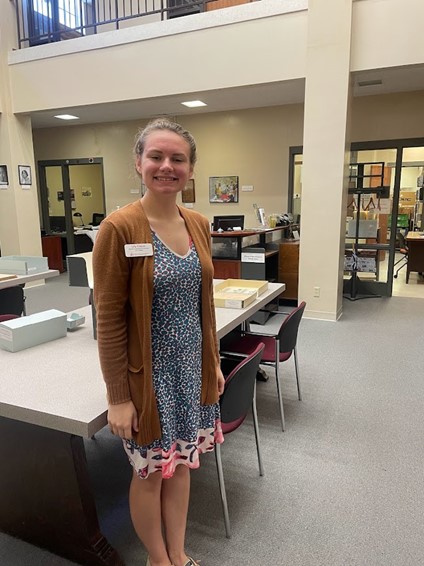
I came to Southeast Missouri State University five years ago for the undergraduate historic preservation program, the only one of its kind in Missouri and one of nine nationwide. While I was exposed to the many pillars of HP, my interests were predominantly archives and records management. Throughout undergrad I worked in Kent Library’s Special Collections and Archives (SC&A), where I gained experience doing local research, arranging archival collections, and writing finding aids. I heard about the new Accelerated Graduate Program my junior year, and soon enough became the department’s fifth student to enroll in the program.
For grad school, I stayed with the SC&A as their graduate assistant, which came with many responsibilities and challenges. I experienced an overall higher level of accountability, meeting with my supervisors regularly to track progress and assign tasks. Moreover, the unit was short-staffed – we only had one full-time archivist and a handful of student workers, so maintaining the day-to-day operations was difficult at times. As I wrap up my time here at SC&A, one project stands out as a marker of my success in this role and has left me with skills I will take into my professional life.
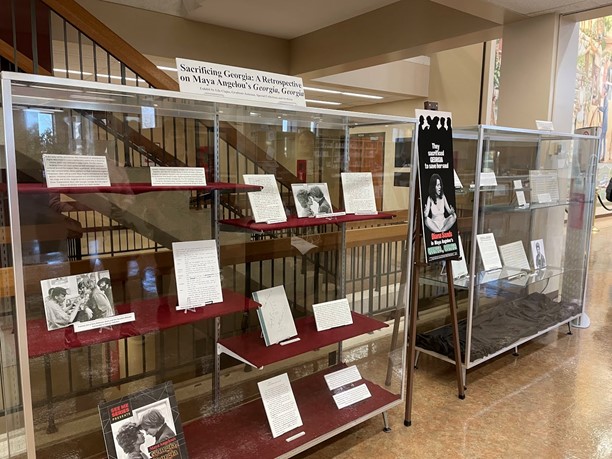
In one of my first meetings with Kent Library dean Barbara Glackin after becoming the graduate assistant, she asked me to take part in an interdepartmental project centered around the 1972 film, Georgia, Georgia, written by Maya Angelou. This project debuted under the Department of Mass Media’s newest initiative to explore diverse creative works, known as the See Me Series. In celebration of its 50th anniversary, over 20 classes integrated the film into an assignment, followed by a public screening and discussion with one of the film’s stars, Dirk Benedict. My task was to create a two-case exhibit about the film for the main floor of Kent Library.

Having taken Dr. Rhodes’ seminar about Cold War America the semester before, I was familiar with both the Vietnam era and the Civil Rights Movement, which helped me understand the significance of this little-known creative work. As the first feature film based on an original screenplay written by a black woman, the film intersected topics of class, race, privilege, prejudice, and sexuality against the backdrop of the Vietnam War, completed by a multicultural cast and crew.
My first task was reaching out to Wake Forest University’s Special Collections and Archives, which manages the Maya Angelou Film and Theater Collection, for materials about Georgia, Georgia. While I have completed many remote research requests within SEMO’s archives, it was eye-opening to interact with an archives as a researcher. From them, I obtained scans of publicity stills, press kits, screen treatments, promotional papers, and even sheet music! I collaborated with Dr. Karie Hollerbach from the Department of Mass Media, the project’s coordinator, to look over the scans and select those items to be displayed in the exhibit. Based on the available materials, we decided that the exhibit would focus on four aspects of the film: plot, production, music, and reception. I then reached out to Wake Forest for permission to display the selected materials and sent our selections to University Marketing to be touched up.
After writing the contextual paragraphs for the exhibit, it was time to actually construct the exhibit. I utilized Kent Library’s large format printer to produce high-quality reproductions of the selected materials, written text, and captions. This ended up being the hardest part, as there was a steep learning curve to operating the printer. All documents were then mounted onto foamboard and cut to size. Dr. Hollerbach dropped off an oversized promotional flyer for the campus screening and the movie’s poster, which turned out to be wonderful additions to the exhibit. With everything scanned, printed, cut, and mounted, it came time to put it all together – although the cases themselves were a bit larger than I anticipated, I am incredibly proud with how it turned out.
 SEMO Historian